Introduction
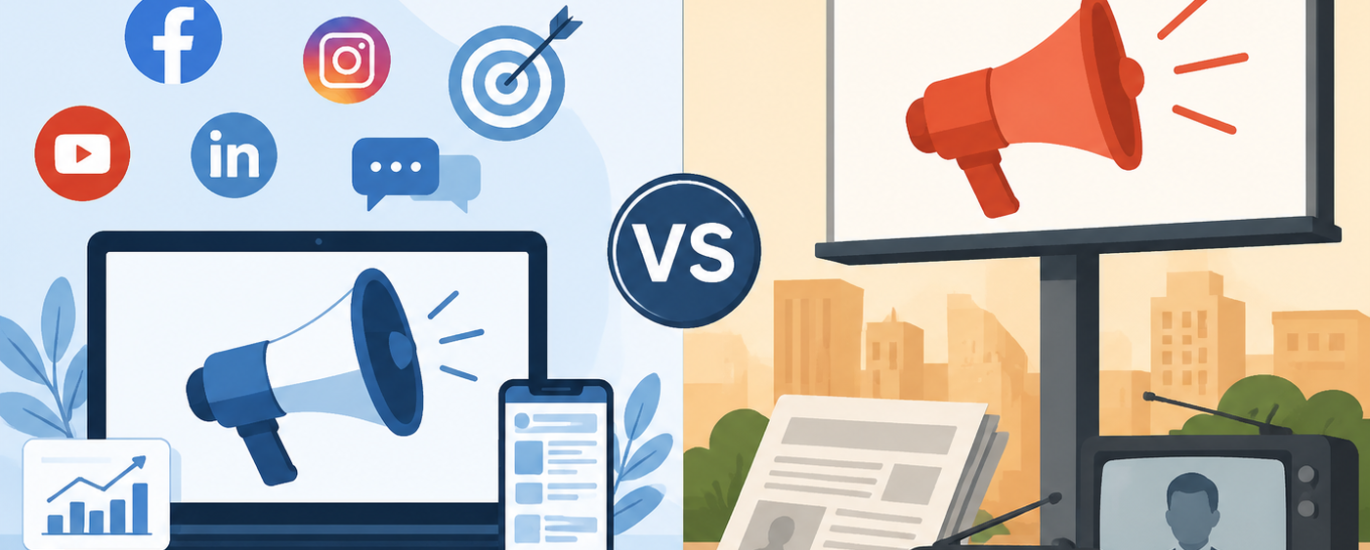
Marketing is one of the most important parts of every business. No matter how good your product or service is, people need to know about it before they can become your customers. This is where marketing plays a vital role. Digital Marketing vs Traditional Marketing is a common comparison that helps businesses understand which marketing approach is more effective. Knowing the difference between Digital Marketing vs Traditional Marketing helps you choose the right strategy to reach your target audience and grow your business successfully.
Today, businesses have two main ways to promote their products and services:
- Traditional Marketing
- Digital Marketing
Many beginners often ask, “What is the difference between Digital Marketing and Traditional Marketing?” or “Which one is better for business?”
The answer depends on your business goals, target audience, and budget. In this guide, we will explain both types of marketing in very simple language so that anyone can understand them easily.
Many beginners often ask, Digital Marketing vs Traditional Marketing—which one is better? The answer depends on your business goals, target audience, and budget. In this guide, you’ll learn the key differences, advantages, disadvantages, and how to choose the right marketing strategy.
What is Marketing?
Marketing is the process of promoting a product or service to the right people. The main goal of marketing is to make people aware of your business, attract customers, and increase sales.
For example, if you own a clothing store, you need to tell people about your products. You can do this through newspaper ads, television commercials, social media, Google Search, email, or your website. All these methods are forms of marketing.
What is Traditional Marketing?
Traditional marketing is the oldest form of marketing. It uses offline channels to promote products and services.
Before the internet became popular, almost every business used traditional marketing.
Some common examples include:
- Newspaper advertisements
- Magazine advertisements
- Television commercials
- Radio advertisements
- Billboards
- Posters
- Flyers
- Brochures
- Banners
- Business cards
Simple Example
Imagine a new restaurant opens in your city.
The owner prints 10,000 flyers and distributes them in nearby areas. He also places a large billboard near a busy road and advertises on the local radio station.
This is called Traditional Marketing because all promotion happens offline.
Advantages of Traditional Marketing
Traditional marketing still offers many benefits.
1. Builds Local Brand Awareness
People in your local area can quickly notice your business through billboards, banners, or newspapers.
2. Easy for Older Audiences
Many older people still prefer newspapers, television, and radio instead of the internet.
3. Physical Advertisements
Printed brochures and business cards give customers something they can keep for future reference.
4. High Brand Recognition
Large TV advertisements and billboards can make a brand look more established and trustworthy.
Disadvantages of Traditional Marketing
Traditional marketing also has some limitations.
- Expensive advertising costs
- Difficult to measure results
- Limited audience reach
- Cannot target specific customers easily
- Campaign changes take time
- Less customer interaction
For small businesses, traditional marketing may not always provide the best return on investment.
What is Digital Marketing?
Digital marketing is the process of promoting products or services using the internet and digital platforms.
Instead of newspapers or television, businesses use websites, search engines, social media, email, and online advertisements.
Today, almost everyone uses smartphones and the internet. This is why digital marketing has become one of the fastest-growing marketing methods.
Examples of Digital Marketing
Some popular digital marketing channels include:
- Search Engine Optimization (SEO)
- Google Ads
- Facebook Marketing
- Instagram Marketing
- LinkedIn Marketing
- Email Marketing
- Content Marketing
- YouTube Marketing
- Affiliate Marketing
- Influencer Marketing
Simple Example
Suppose you own an online shoe store.
Instead of printing flyers, you:
- Create a website
- Write helpful blog articles
- Rank your website on Google using SEO
- Run Google Ads
- Share product videos on Instagram
- Send promotional emails
All these activities are examples of Digital Marketing.
Advantages of Digital Marketing
Digital marketing offers many benefits for businesses of all sizes.
1. Lower Cost
Compared to TV or newspaper advertisements, digital marketing is much more affordable.
Even small businesses can promote their products with a limited budget.
2. Reach a Global Audience
A website can be accessed by people from different cities and countries.
Your business is no longer limited to your local area.
3. Better Targeting
You can show advertisements based on:
- Age
- Location
- Gender
- Interests
- Language
- Online behavior
This improves the chances of getting more customers.
4. Easy to Measure Results
Digital marketing tools show:
- Website visitors
- Clicks
- Leads
- Sales
- Conversion rates
This helps businesses understand what is working.
5. Fast Changes
If an advertisement is not performing well, you can update it immediately.
Traditional marketing usually cannot be changed after printing or publishing.
6. Better Customer Engagement
Customers can:
- Like your posts
- Comment
- Share content
- Send messages
- Leave reviews
This creates stronger relationships between businesses and customers.
Disadvantages of Digital Marketing
Although digital marketing offers many benefits, it also has some challenges.
- High competition
- Requires continuous learning
- Google algorithm updates
- Social media algorithm changes
- Need for quality content
- Internet connection required
However, these challenges can be managed with proper planning and regular practice.
Digital Marketing vs Traditional Marketing
| Feature | Digital Marketing | Traditional Marketing |
|---|---|---|
| Platform | Internet | Offline Media |
| Cost | Lower | Higher |
| Audience Reach | Global | Mostly Local |
| Results | Easy to Measure | Difficult to Measure |
| Targeting | Highly Specific | General Audience |
| Customer Interaction | High | Limited |
| Campaign Changes | Instant | Slow |
| Return on Investment | Usually Higher | Often Lower |
| Speed | Fast | Slower |
| Best For | Businesses of All Sizes | Local or Large Offline Campaigns |
Which Marketing is Better?
There is no single answer because it depends on your business.
Traditional marketing works well when:
- You want to target local customers.
- Your audience watches TV or reads newspapers.
- You are promoting local events.
Digital marketing works better when:
- You want more website traffic.
- You want online sales.
- You have a limited budget.
- You want measurable results.
- You want to reach customers across different locations.
Today, many successful businesses use both traditional and digital marketing together to get the best results.
Example Comparison
Imagine two clothing stores.
Store A
The owner prints newspapers, flyers, and banners.
He spends a lot of money.
He cannot easily know how many people purchased because of the advertisement.
Store B
The owner builds a website.
He writes SEO-friendly blogs.
He runs Google Ads.
He promotes products on Instagram and Facebook.
He checks website visitors using analytics.
He knows exactly which advertisement generated sales.
Most modern businesses prefer this approach because it provides better tracking and higher returns.
Why Businesses are Choosing Digital Marketing
Many businesses are moving towards digital marketing because:
- More people use smartphones.
- Online shopping is increasing.
- Internet users continue to grow.
- Customers search on Google before buying.
- Social media influences purchasing decisions.
- Online advertising provides measurable results.
Digital marketing allows businesses to reach the right audience at the right time with the right message.
Tips for Beginners
If you are new to digital marketing, start with these steps:
- Learn the basics of digital marketing.
- Understand how SEO works.
- Create a simple website or blog.
- Learn keyword research.
- Write helpful content regularly.
- Create social media profiles.
- Learn Google Analytics.
- Practice consistently.
- Stay updated with new trends.
- Keep learning and improving.
Digital Marketing vs Traditional Marketing: Key Differences
1. Audience Reach
Traditional marketing mainly targets local or regional audiences. Digital marketing allows businesses to reach customers across cities, countries, and even globally.
2. Targeting
Digital marketing lets you target people based on age, interests, location, and online behavior. Traditional marketing reaches a broader audience without precise targeting.
3. Performance Tracking
One of the biggest advantages of digital marketing is real-time analytics. Businesses can track website traffic, clicks, leads, and sales. Traditional marketing offers limited performance measurement.
4. Customer Engagement
Digital marketing encourages direct interaction through social media, emails, comments, and live chat. Traditional marketing usually provides one-way communication.
Final Thoughts
Both Digital Marketing and Traditional Marketing have their own strengths. Traditional marketing has been used successfully for many years and is still useful for local businesses and offline promotions. However, the world has changed. Today, most customers search online before making a purchase, which makes digital marketing more important than ever.
Digital marketing offers better targeting, lower costs, measurable results, and the ability to reach customers anywhere in the world. It also allows businesses to interact directly with their audience and improve campaigns based on real data.
For beginners, learning digital marketing is a smart investment because it opens career opportunities and helps businesses grow in today’s digital world. If possible, businesses should combine both traditional and digital marketing to create a balanced marketing strategy and achieve the best results.
Frequently Asked Questions (FAQs)
1. What is the main difference between Digital Marketing and Traditional Marketing?
Traditional marketing uses offline channels like newspapers, TV, radio, and billboards, while digital marketing uses online platforms such as websites, search engines, social media, email, and online ads.
2. Which marketing is more affordable?
Digital marketing is generally more affordable because businesses can start with a small budget and scale as they grow.
3. Which marketing gives faster results?
Paid digital marketing campaigns like Google Ads and social media ads can generate traffic and leads very quickly. SEO takes longer but provides long-term benefits.
4. Can small businesses use digital marketing?
Yes. Digital marketing is one of the best options for small businesses because it offers affordable advertising, better targeting, and measurable results.
5. Should a business use both digital and traditional marketing?
Yes. Combining both methods can help businesses reach a wider audience and build a stronger brand presence, especially if they serve both online and offline customers.
Conclusion
When comparing Digital Marketing vs Traditional Marketing, there is no one-size-fits-all answer. Traditional marketing remains valuable for offline branding, while digital marketing offers better targeting, flexibility, and measurable results.
For most modern businesses, digital marketing provides the greatest opportunities for growth. By understanding the strengths of Digital Marketing vs Traditional Marketing, you can choose the right strategy to reach your audience, increase sales, and build a successful business.